Is Inventory Rising While Sales Slow? Here’s What January 2026 Market Data Shows
The Philadelphia housing market entered 2026 with mixed signals. While home prices continue to rise and inventory is expanding, overall sales activity has slowed compared to this time last year. This shift reflects a market that is adjusting — not collapsing — as buyers and sellers adapt to current interest rates, seasonal timing, and broader economic conditions.
Here’s a closer look at what happened across the Philadelphia metro housing market in January 2026.
Home Prices Continue to Climb
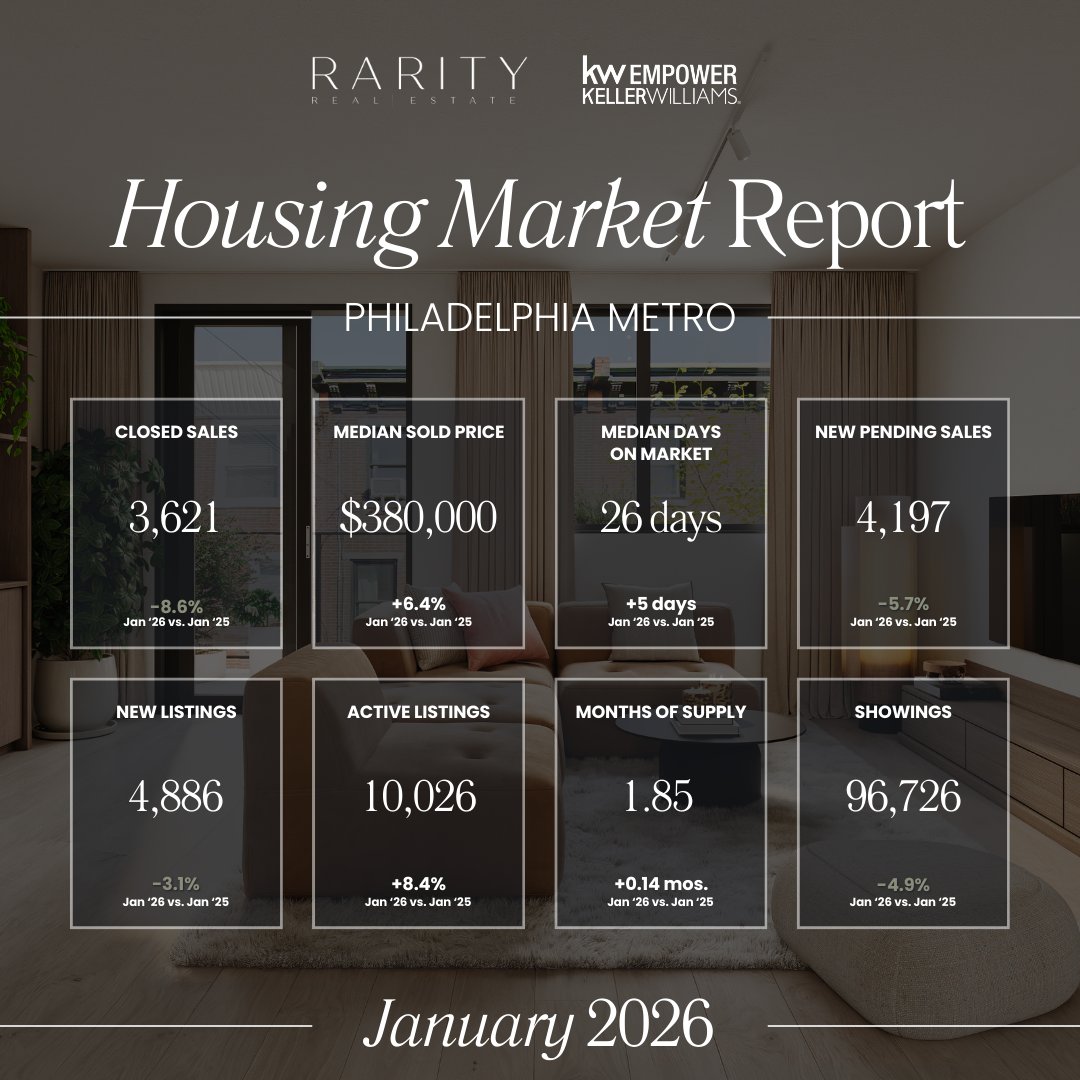
The median sold price across the Philadelphia metro reached $380,000, representing a 6.4 percent increase compared to January 2025. This continued price growth highlights an important reality: despite fluctuations in activity, home values remain strong.
Price increases are being supported by limited long-term housing supply and consistent demand from buyers who are financially prepared and committed to entering the market. Well-presented homes in desirable locations are still commanding strong offers.
For homeowners, this means equity positions remain healthy, and in many cases, stronger than ever.
Closed Sales Slowed Compared to Last Year
There were 3,621 closed sales in January, marking an 8.6 percent decrease year over year.
This decline is not unexpected. January is traditionally one of the slower months of the year due to winter weather, holiday carryover, and buyers waiting for the spring market. Additionally, higher interest rates compared to prior years continue to influence buyer timing and affordability.
However, slower sales volume does not necessarily indicate weakening values. Instead, it reflects a more selective buyer pool — one that is still active, but more intentional.
Inventory Is Increasing, Giving Buyers More Options
One of the most important shifts in the market is the increase in available inventory. There were 10,026 active listings in January, representing an 8.4 percent increase compared to last year.
This increase gives buyers more choices than they had during the extremely tight inventory conditions of previous years. At the same time, overall supply remains relatively limited when compared to historical norms.
The market currently has 1.85 months of supply, which still falls well below the 4 to 6 months typically considered a fully balanced market. This means sellers continue to hold an advantage — but buyers are gaining more breathing room.
Homes Are Taking Slightly Longer to Sell
The median days on market increased to 26 days, which is five days longer than January 2025.
This shift reflects a more normalized pace compared to the ultra-fast market conditions seen during the peak years of 2021 through 2023. Homes are still selling efficiently, but buyers are taking slightly more time to evaluate options.
Strategic pricing and proper presentation remain critical for sellers who want to attract strong offers quickly.
New Listings and Buyer Activity Are Showing Seasonal Patterns
There were 4,886 new listings in January, a slight 3.1 percent decrease compared to last year. Meanwhile, new pending sales declined by 5.7 percent, and total showings decreased by 4.9 percent.
These numbers reflect typical seasonal behavior. January is often a transitional month, with both buyers and sellers preparing for increased activity in the spring.
Historically, inventory and buyer activity begin to rise steadily starting in late February and March.
What This Means for Buyers and Sellers
The January data shows a market that is stabilizing, not slowing dramatically.
For sellers, rising prices and limited supply continue to support strong opportunities, especially for homes that are well-prepared and priced correctly. Looking to sell your home in 2026? Check out our complete checklist to prepare before you list.
For buyers, increasing inventory provides more choices and slightly less competition compared to previous years. This creates an opportunity to enter the market with more negotiating power than during peak competitive periods.
Looking Ahead to Spring 2026
As we move toward the spring market, activity is expected to increase across the region. New listings will likely rise, bringing more opportunities for buyers, while continued demand will help support home values.
The Philadelphia housing market remains resilient, balanced, and active, positioning both buyers and sellers for opportunities in the months ahead.
Source: Market data provided by Bright MLS for the Philadelphia Metro region, January 2026.